An Empirical Determination Of The Cosmic Shoreline
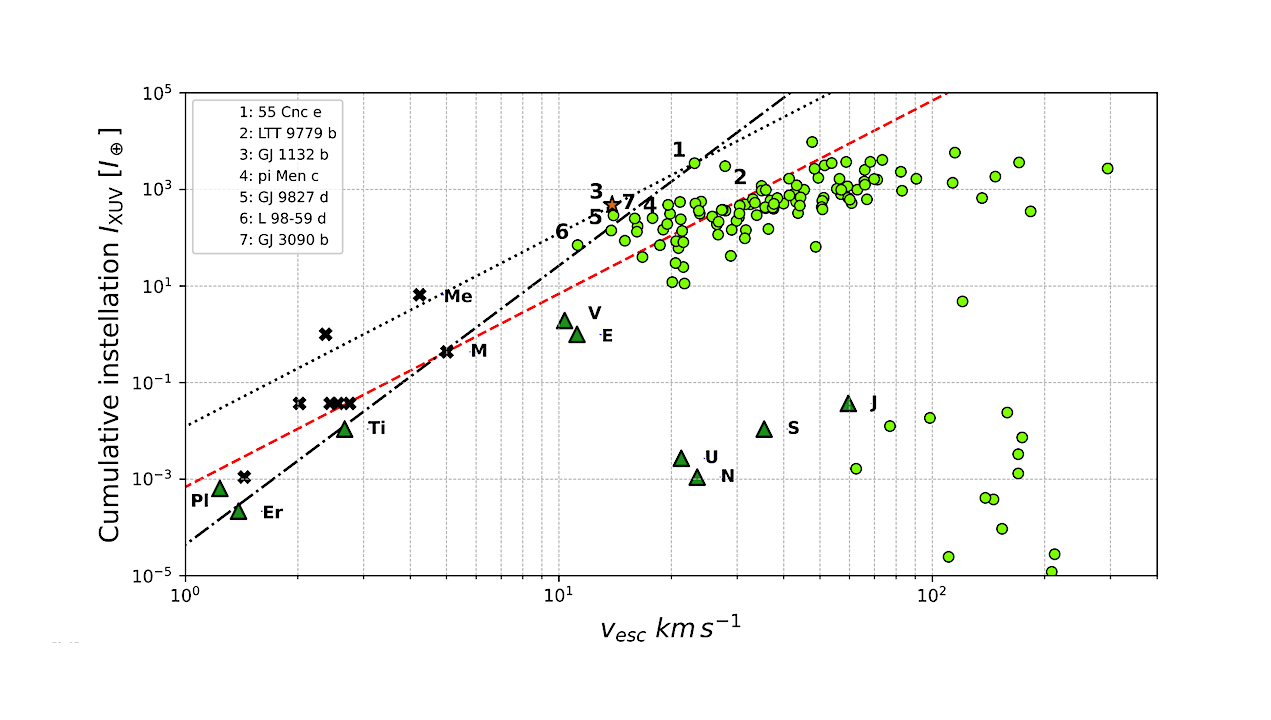
The cosmic shoreline concept was introduced to separate planets with atmospheres from those without, by relating the cumulative X-ray and extreme-ultraviolet (XUV) instellation (integrated over the planet’s lifetime) to the planetary escape velocity, using the Solar System planets to anchor the empirical relation.
The exoplanet community has since attempted to refine the cosmic shoreline to provide a consistent ranking or prioritisation tool for exoplanet observations – i.e., to quickly identify which small planets are most likely to have retained an atmosphere and therefore merit expensive follow-up with facilities such as JWST or the upcoming ELTs.
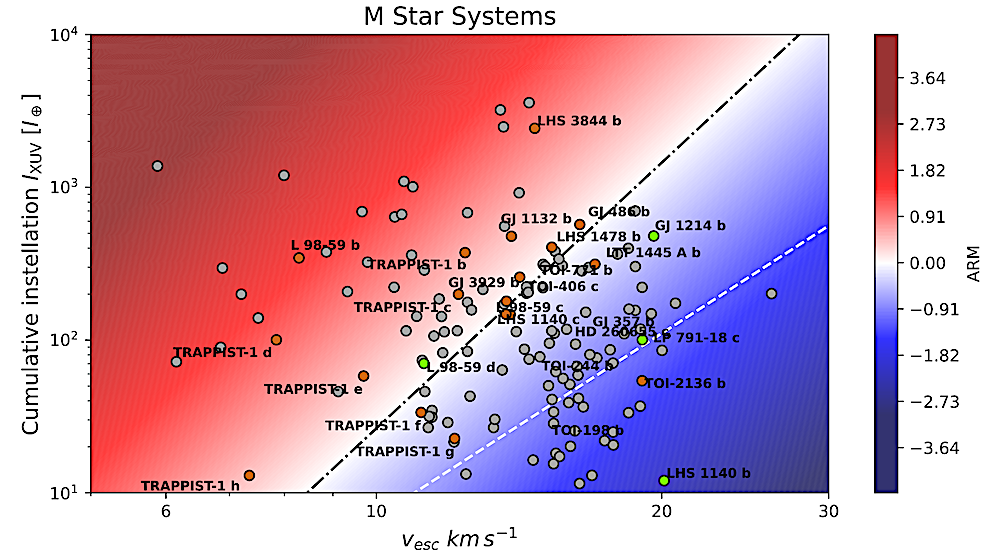
Cosmic Shoreline for all known planetary systems orbiting M-dwarf-type stars. The black dashed-dotted line is our newly proposed Empirical Exoplanet Cosmic Shoreline (EECS) and the white-dashed line is the classical cosmic shoreline, same as in Figure 1. The gray points mark the systems whose atmospheres have not been studied; the orange ones mark the planets with reported strong non-detections; and the light-green ones mark the planets with a (tentative) atmosphere detection. — astro-ph.EP
Here, we use an empirical approach to refine the Cosmic Shoreline concept. In particular, we used the data provided by the ExoAtmospheres database, and the NASA Exoplanet Archive, along with solar system data. We reconcile limitations in the classical shoreline definition by anchoring our Empirical Exoplanet Cosmic Shoreline (EECS) simultaneously to Mars, GJ 9827 d, L 98-59 d, GJ 3090 b, and Pi Mensae c (all having tentative atmospheric detections).
The EECS exhibits a significantly steeper slope than previously theorized, while consistently categorising Solar System moons and dwarf planets according to their atmospheric properties. Applied to planets orbiting M dwarfs, the EECS suggests that a larger fraction retain atmospheres than predicted by classical models, but incorporating revised XUV fluence histories for low-mass M dwarfs reveals severe atmospheric vulnerability.
We finally identify high-priority targets for the JWST Rocky Worlds survey and future ELTs observations based on their EECS positioning and Transmission/Emission Spectroscopy Metrics.
Pedro Meni-Gallardo, Enric Pallé
Comments: Accepted for publication in MNRAS on 2026 June 15
Subjects: Earth and Planetary Astrophysics (astro-ph.EP)
Cite as: arXiv:2508.12865 [astro-ph.EP] (or arXiv:2508.12865v2 [astro-ph.EP] for this version)
https://doi.org/10.48550/arXiv.2508.12865
Focus to learn more
Submission history
From: Pedro Pablo Meni Gallardo
[v1] Mon, 18 Aug 2025 12:03:57 UTC (1,688 KB)
[v2] Tue, 16 Jun 2026 22:01:01 UTC (1,776 KB)
https://arxiv.org/abs/2508.12865
Astrobiology, Exoplanet,